

 English
 Español

Gas Line in a Car: How Fuel Lines Work, Why They Fail, and How to Replace Them
Content
- 1 What the "gas line in a car" actually means
- 2 How fuel actually reaches the engine
- 3 Which material belongs where
- 4 Pressure is what decides the repair
- 5 Signs the gas line is failing
- 6 What actually causes a gas line to fail
- 7 Choosing a replacement that fits the first time
- 8 Injector feed pipes: the highest-pressure lines on the car
- 9 If "gas line" means CNG or LPG
- 10 Frequently asked questions
You park, switch the engine off, and the smell arrives a second later - raw gasoline, sharp, coming from somewhere under the rear seat. Nothing is dripping on the driveway. That is usually the moment people start searching for "gas line in car", and it is also the moment to stop driving until someone has looked at it.
The short version: the gas line in a car is the sealed path that carries fuel from the tank to the injectors under pressure. On most vehicles that means a supply line, sometimes a return line, a separate vapour line for the emissions system, and short injector feed pipes at the engine. When any of them weeps or vents, the danger is not the puddle - it is the vapour, which is heavier than air, collects under the floor pan and ignites from a hot exhaust or a single spark.
Below is how the circuit is built, which materials survive modern fuel, what the failure signs look like in practice, and how to specify a replacement that fits the first time.
What the "gas line in a car" actually means
Ask two people and you get two answers. In North America the phrase almost always means the gasoline fuel line; in a CNG or LPG vehicle it means a completely different and much higher-pressure circuit. Even inside a gasoline car, "gas line" is a family of parts, not one hose:
- Supply line - carries fuel from the tank or in-tank pump forward to the filter and rail. This is the line that still holds pressure after you switch off.
- Return line - sends unused fuel back to the tank on return-style systems. Many modern cars are returnless and do not have one.
- EVAP (vapour) line - vents the tank to the charcoal canister and purge valve. It carries vapour, never liquid fuel.
- Injector feed pipes - short, thick-walled pipes from the rail to each injector; on diesel engines these carry the full rail pressure.
Underneath the car, hard lines are clipped to the floor pan and change to short flexible sections at the tank, the filter and the firewall. That hard-to-flex transition is where most failures begin, because it is the only place the line has to absorb engine movement.
 Fuel Supply Line for Corrosive Fuels and High PressuresMultilayer fuel supply line resistant to E10 and biodiesel, with a low-permeation EVOH barrier and custom 3D routing for tank-to-rail assemblies.View Product →
How fuel actually reaches the engine
Follow the route once and the failure points stop being mysterious. Fuel leaves the tank, passes a filter, runs forward along one side of the floor pan, and terminates at the rail - with a short flexible joint at each end.
Most cars built in the last twenty years use a returnless layout: the regulator sits inside the tank module, one line runs forward, and pressure is set at the pump. That deletes a return line and two connections, so there are fewer leak points - but the system is also less forgiving of a partly blocked filter, because a restriction shows up directly as low rail pressure.
Which material belongs where
Fuel line is not one specification. A length of rubber hose off a roll and a crimped nylon-and-steel assembly look similar in a photo and behave nothing alike at 60 psi, let alone at 2,000 psi.
| Construction | Typical use | Pressure class | Ethanol blends | Weak point |
|---|---|---|---|---|
| Nitrile rubber hose (SAE J30 R7) | Low-pressure feed and return on older cars | Around 50 psi | E10 only | Hardens, then weeps at the clamp |
| Injection-rated hose (SAE J30 R9) | Repair sections and tank stubs on EFI cars | Around 100 psi working | E10 and E85 versions | Lower grades sold as "fuel hose" |
| Braided stainless over PTFE | Motorsport, off-road, high-pressure retrofits | 1,000 psi and above | Good | Chafes whatever it rubs against |
| Nylon tube (PA) | OEM supply and EVAP runs | High, system dependent | Good, low permeation | Kinks; needs the correct insert and fitting |
| Coated steel or stainless hard line | Underbody chassis runs | High | Water in E10 rusts it from inside | Rust pinholes at the clips |
| 316 stainless tube (CNG) | Compressed natural gas high-pressure circuit | 200 bar and above | Not applicable | Certified fittings and testing required |
Two rules cover most of the confusion: never fit a hose with a lower SAE rating than the line it replaces, and never join a high-pressure line with a barbed union and a worm-drive clamp. If the original part is a one-piece crimped assembly, the replacement should be too.
Pressure is what decides the repair
The same 8 mm line can see 50 psi or 29,000 psi depending on the injection system bolted to the other end. That difference, not the diameter, is what tells you whether a repair is possible at the roadside.
Typical operating ranges: port injection around 40 to 60 psi, gasoline direct injection 2,000 to 2,900 psi, and common-rail diesel between roughly 1,800 and 2,500 bar. At 50 psi a clamp might hold long enough to reach a workshop. At 2,000 psi the same clamp will spray atomised fuel across a hot exhaust manifold within seconds of the engine catching.
Signs the gas line is failing
A line can be well on its way to failing without leaving a single drop on the ground. Watch for this combination rather than a single symptom:
- Fuel smell after parking - strongest in a hot engine bay or around the rear wheel arch, and often worse just after refuelling.
- Damp patches you cannot see easily - staining on top of the tank or on the line where it passes behind a clip is a classic early sign.
- Hissing or whistling when the key is turned to prime the pump, before the starter is engaged.
- Long cranking and hard cold starts - pressure bleeds away overnight through a weeping joint.
- Lean fuel trims - P0171 or P0172 stored, or a P0087 rail pressure code on a direct-injection engine.
- Rising consumption with no change in driving pattern, or a raw-fuel smell in the oil on older port-injection engines.
Smell alone is enough reason to stop. Gasoline vapour is explosive well below the concentration where you would describe the smell as strong, and the cabin sits directly above the lines.
What actually causes a gas line to fail
- Corrosion from the inside out. Ethanol blends hold water, and coated steel lines rust first at the plastic clips where the coating is scuffed.
- Age and heat cycling. Rubber hardens, loses plasticiser and cracks at the crimp collar long before the hose body shows damage.
- Vibration. A missing or broken clip turns a line into a fatigue test rig; fractures appear at the hard-to-flex transition.
- Chafing and road debris. A line resting against a subframe will wear through given enough miles.
- Wrong material for the fuel. E85 in a hose that is not rated for it swells the inner liner and softens the bond to the fitting.
- Previous bad repairs. Compression fittings and hose clamps on an injection line are a scheduled failure, not a repair.
- Fitting defects. A rolled O-ring or a retaining clip that was never fully seated leaks under pressure but often passes a static check.
Most of these start at a joint rather than in the middle of a straight run, which is why a proper inspection means looking at every connection and every clip, not just the section you can reach from the creeper. Our guide to preventing leaks at automotive pipe fittings covers the sealing details in more depth.
Choosing a replacement that fits the first time
Fuel lines are among the few parts where "close enough" is genuinely unsafe. Specifying the right assembly comes down to a short checklist:
- Match the OE number, not just the model year - the same platform frequently carries two different routings.
- Match the connection type: quick-connect with a retaining clip, flare, banjo, or push-on with an O-ring.
- Buy the complete assembly where a hard line and a flexible section are crimped together. Cutting that joint and clamping it is not a field repair.
- Confirm material and wall thickness: stainless for hot, exhaust-adjacent runs, nylon or coated steel under the floor, hose marked for injection service at the tank stub.
- Check length and bend radius so the part sits in the original clips without tension, then cycle the key several times and inspect for weeping before the first drive.
Our own production runs on CNC benders, 800T hydroforming, brazing furnaces and laser welding cells in Ningbo, and each assembly is built to the OE number it replaces rather than to a generic length of tube. That matters most on the lines that curve around the tank, where a two-millimetre difference in routing shows up as a chafed line two years later.
Injector feed pipes: the highest-pressure lines on the car
Between the rail and each injector sits a short, thick-walled pipe, usually with a forged nut at both ends and a vibration damper wrapped around the middle. On a common-rail diesel these pipes see the full rail pressure, and they are the one part of the fuel system where a visible crack is not a slow leak - it is a fine jet aimed at the cylinder head.
A failing injector pipe usually announces itself as a diesel smell in the engine bay at idle, a single-cylinder misfire, black deposits around the pipe nut, and often a rail pressure or cylinder balance code. Replace the pipe rather than re-torquing it: the seat deforms to seal, and it will not seal twice.
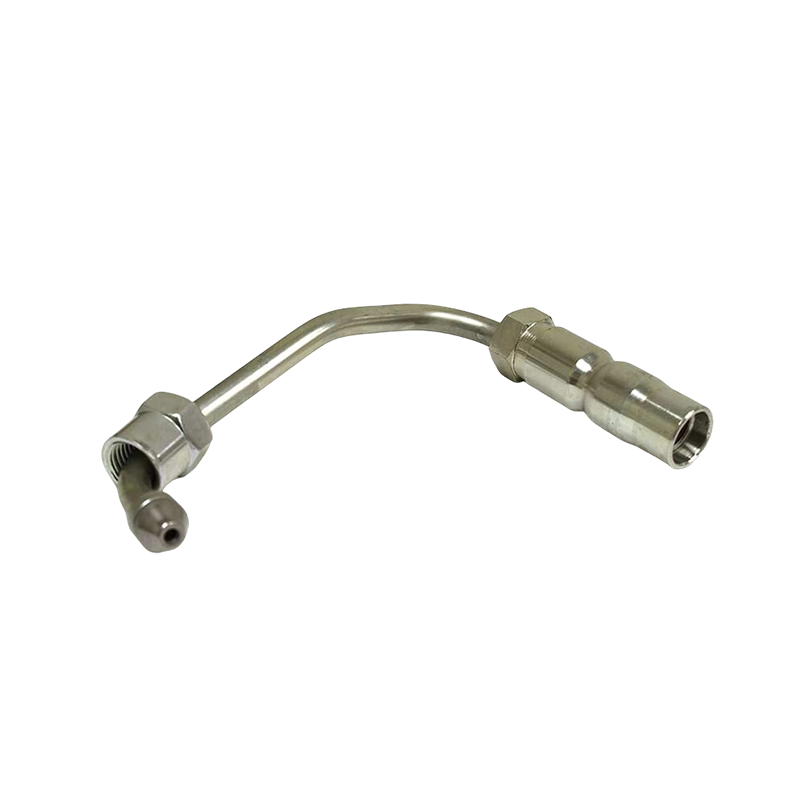 Common Rail Fuel Injector Feed PipePrecision alloy-steel common-rail injector pipe with autofrettage prestressing and ISO 4406 cleanliness, suited to replacement when diesel leaks or misfire occur.View Product →
If "gas line" means CNG or LPG
Compressed natural gas cars store fuel at up to 200 to 250 bar in the cylinder, so the line between cylinder and regulator is normally rigid 316 stainless with certified fittings, a manual shut-off valve and a pressure relief device. LPG liquid lines run at far lower pressure, typically around 5 to 10 bar, but are still copper or steel with purpose-made connectors. Neither circuit accepts rubber hose, and neither should be worked on without releasing pressure and following the vehicle manufacturer's procedure - the fittings and test requirements are different from anything in the gasoline section above.
Frequently asked questions
Vapour escapes before liquid does. A pinhole, a dried hose end or a rolled O-ring in a quick-connect can pass vapour for months before a wet spot appears. The smell is usually strongest right after refuelling or after the car sits hot.
No. A pressurised line can turn a pinhole into a spray, and vapour ignites from the exhaust, a starter motor or a static spark. Have the car towed or repaired where it stands.
On most vehicles the line is the smaller part of the bill and labour dominates, because a tank drop, intake removal or subframe drop may be involved. Ask for a quote by OE number so every offer covers the same part.
Hard lines normally last the life of the vehicle, but rubber sections and crimped flex joints are wear items - six to ten years is realistic in salt-belt or high-ethanol use. Lines that have lost their clips age far faster.
5/16 inch (8 mm) is the common size for gasoline supply lines, 3/8 inch (9.5 mm) appears on higher-flow and diesel applications, and return lines are often smaller. Diameter alone means little; the pressure rating matters more.
No. Barbed fittings and worm-drive clamps are not rated for injection pressures. Cut-and-clamp is acceptable only on low-pressure return or vent lines with hose marked for fuel service, and a crimped assembly is still the better choice.
The gas line in a car is a simple idea with very little tolerance for improvisation: correct material, correct pressure class, correct fittings, and no shortcuts at the joints. If you are replacing a line, start from the OE number and work outward - or browse our automotive pipe range to match the exact assembly your vehicle was built with.
Our Main Products

 Contact Us
+86-138 0586 3066
+86-574 8840 6311
 Products
 Send An E-mail
 Mobile
Copyright ©NINGBO JIATIAN AUTOMOBILE PIPE CO.,LTD. All Rights Reserved.
 China's Premium Automotive Tube Factory
Custom Automotive Pipe Fittings Supply
privacy