

 English
 Español

Fuel Line Size Guide: ID, AN, and Metric Sizing for Stock and Performance Builds
Content
- 1 What Fuel Line Size Do You Need? Start With These Four Benchmarks
- 2 Inside Diameter Is the Number That Decides Flow
- 3 5/16 in. and 8 mm Look Alike and Do Not Always Fit Alike
- 4 Performance Builds: Size the Line to Fuel Demand
- 5 Material, Wall Thickness, and Fittings Change What Fits
- 6 How to Match and Order a Replacement Fuel Line
- 7 What to Verify Before a Fuel Line Order Ships
- 8 Frequently Asked Questions
A leaking steel fuel line on a 2013 pickup should be a simple order. Then the catalog lists 5/16 in., 8 mm, and 3/8 in. for the same engine family, and the customer wants to know which one is correct. The answer is not a matter of preference — it is a dimension, and getting it wrong shows up later as a kinked line, a weeping quick-connect, or a lean fuel trim code three weeks after the repair.
Fuel line size, in almost every practical case, means the inside diameter (ID) of the line carrying liquid fuel from the tank or pump to the injectors. On a stock vehicle, the correct size is the size the factory specified — most often 5/16 in. (8 mm) or 3/8 in. (9.5 mm) ID on the feed side, with the return line one step smaller. On a modified or performance build, the size is set by how much fuel the engine actually consumes and how much pressure drop the system can tolerate. Everything else — AN numbers, nominal inch fractions, hose construction — is a labeling system layered on top of those two facts.
What Fuel Line Size Do You Need? Start With These Four Benchmarks
Most production vehicles and mild performance builds fall into a narrow range. These are the sizes you will see most often when you measure an original line on the bench:
- 1/4 in. (about 6 mm) ID — low-flow return lines, small carbureted fuel systems, and vapor lines on older vehicles.
- 5/16 in. (about 8 mm) ID — the most common feed-line size on passenger cars and light trucks; many OEM nylon and coated steel lines land here.
- 3/8 in. (9.5 mm) ID — feed lines on many V8 and diesel applications, and the usual starting point for a performance feed line.
- 1/2 in. (12.7 mm) ID and larger — high-horsepower EFI, large-displacement diesel, and any build where the pump moves serious volume.
Treat those numbers as a starting point, not a specification. A line that is correct for one engine calibration may be marginal on another, because pump pressure, fuel type, and injector flow all shift the requirement. The authoritative answer always comes from the original equipment part number or the fuel system manufacturer's published data.
Inside Diameter Is the Number That Decides Flow
Buyers regularly confuse inside diameter, outside diameter, and nominal size. A hose sold as "3/8 in." may measure 0.375 in. across the outside and something quite different through the bore, because wall thickness varies with construction. Two lines can share the same OD and behave completely differently in service — one may carry enough fuel at low velocity, the other may act as a restriction.
AN sizing adds another layer. AN numbers describe the outside diameter in sixteenths of an inch, not the bore. An AN-6 fitting measures 6/16 in. (3/8 in.) on the outside of the hose it accepts, but the actual flow area depends on whether the hose is rubber-braided, PTFE-lined, or a rigid tube. This is why two AN-6 hoses from different constructions can differ measurably in ID.
| Nominal inch size | Approx. ID | Common metric match | AN size with same OD | Typical use |
|---|---|---|---|---|
| 1/4 in. | 6.4 mm | 6 mm | AN-4 | Return lines, low-flow carbureted feed |
| 5/16 in. | 7.9 mm | 8 mm | AN-5 | OEM feed on most passenger cars |
| 3/8 in. | 9.5 mm | 9.5–10 mm | AN-6 | OEM feed on V8 and diesel; common performance feed |
| 1/2 in. | 12.7 mm | 12–13 mm | AN-8 | High-horsepower EFI, large diesel |
Inside diameters above are nominal. Confirm the actual bore against the hose or tube manufacturer's data sheet before committing to a fitting.
5/16 in. and 8 mm Look Alike and Do Not Always Fit Alike
Eight millimeters converts to 0.315 in.; 5/16 in. equals 0.3125 in. The gap is roughly 0.06 mm — invisible on a tape measure, but enough to change how a line seats on a push-connect fitting, a formed bead, or a spring clip. The same applies to 3/8 in. (9.53 mm) versus 10 mm (0.394 in.), where the difference approaches half a millimeter.
On a clamped rubber connection over a barb, that tolerance is usually absorbed by the clamp. On a nylon line with a factory-formed end, or a steel line secured by a retaining clip, it may not be. Matching the original specification — part number, bore, and fitting type together — avoids the callback that comes from a line that "looks right" and weeps under pressure.
Automotive Fuel Supply Line with Precise ConnectorsUseful when engine modifications change fuel sizing: this line supports leak-proof connections, corrosive-fuel resistance, and precise 3D routing.View Product →Performance Builds: Size the Line to Fuel Demand
Once the engine is modified, the factory dimension stops being the reference point. Sizing becomes a fluid problem: deliver the required mass of fuel without excessive pressure loss between the pump and the rail. Two practical consequences follow.
First, fuel type changes volume. E85 requires roughly 25 to 30 percent more fuel volume than gasoline for the same energy output, so a feed line that is comfortable on pump gasoline can become marginal on ethanol blends. Second, velocity in the pressure line matters more than most builders expect. A commonly used design guideline is to keep fluid velocity in the supply line below about 4 ft/s, because higher velocity increases friction loss and Reynolds number, which translates into a pressure drop that the regulator and pump have to fight.
Return lines are sized differently. They run at low pressure but must return volume freely; an undersized return raises base pressure at idle and makes regulator behavior unpredictable. A common approach is one size smaller than the feed — 3/8 in. feed with 5/16 in. return on a moderate build — but that ratio should be checked against the regulator manufacturer's recommendation rather than assumed.
Diesel systems add their own constraint. The low-pressure supply side and the high-pressure injection lines are separate components with separate sizing rules, and the high-pressure side is defined by the injection system, not by horsepower estimates.
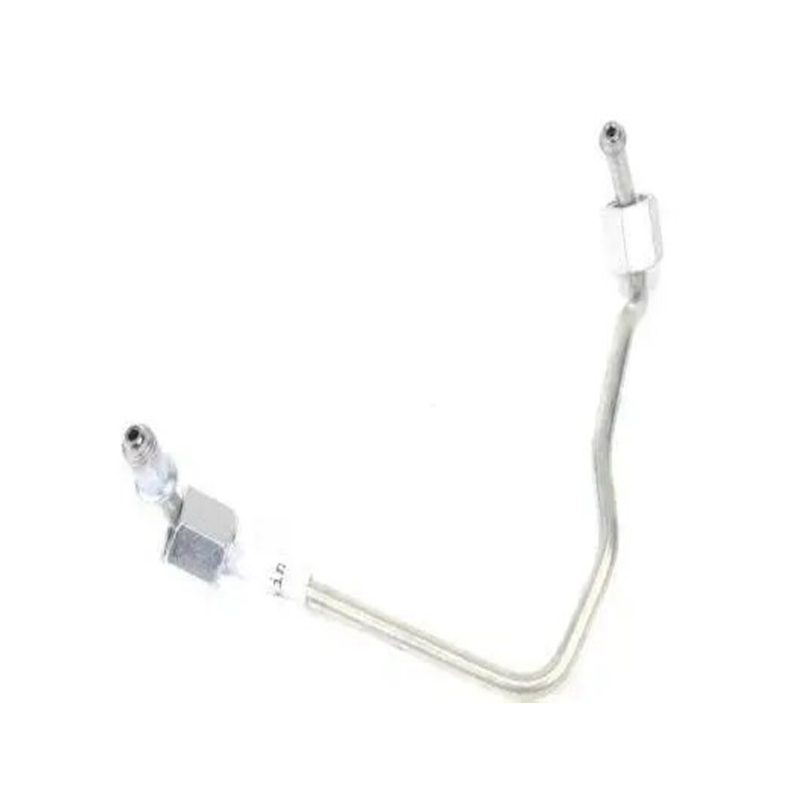 Precision Diesel Injection Line OE 98063063 ReplacementFor diesel high-pressure systems, this replacement feed pipe restores OE-fit fuel delivery and leak-free performance under pulsating pressures.View Product →
Material, Wall Thickness, and Fittings Change What Fits
The same nominal size behaves differently depending on construction. Coated steel and zinc-nickel tubing hold a fixed bore and resist underhood heat, which is why most OEM feed lines are rigid or semi-rigid. Nylon tubing is lightweight and inexpensive to form but has a larger bend radius and less resistance to exhaust radiant heat. PTFE-lined hose handles ethanol blends and higher pressures well, with a thinner wall and a correspondingly smaller OD for a given bore. Rubber fuel hose should carry a marking referencing an SAE J30 specification so the buyer knows the permeability and pressure class.
Wall thickness drives two things buyers forget: bend radius and fitting compatibility. A thick-wall line resists collapse on a tight bend but needs more space behind the engine; a thin-wall performance hose bends easily but may kink without an external spring or braid. On the injector side, the same logic applies to fuel injector feed pipes, where bore and end-form must match the rail and the injector inlet together.
How to Match and Order a Replacement Fuel Line
- Identify the OE number first. VIN-based lookup beats visual matching for any vehicle produced in more than one configuration.
- Measure the bore, not the outside. Use a caliper or a set of bore gauges on a straight, undeformed section at least 25 mm from any fitting.
- Record the end form. Quick-connect, inverted flare, banjo, barb, or O-ring boss — each has its own sealing requirement and cannot be substituted casually.
- Map the routing. Note the number of bends, the approximate bend angles, and the clip locations. A dimensionally correct line with the wrong routing will rub or preload a fitting.
- Confirm material and coating. Stainless where exhaust heat is close, coated steel elsewhere, reinforced hose only where flexibility is required.
- Order against the specification, not the photo. Ask the supplier to confirm bore, end form, and material on the quotation.
If the target is a specific cylinder rather than the whole rail feed, this guide on choosing the right fuel injector pipe covers the selection points in more detail.
Fuel Line Category: Pipes, Filters and FittingsBrowse this fuel line category for low- and high-pressure pipes, filters, regulators, seals, and fittings, with options for leak-proof connections and custom routing.View Product →What to Verify Before a Fuel Line Order Ships
Sizing is only half of the purchase. The other half is whether the parts in the carton hold the dimension that was quoted. A short verification list for any replacement fuel line batch:
- Bore and end-form dimensions checked against the drawing, not just against a sample.
- Pressure and leak testing on every assembly, with the test pressure recorded.
- Coating thickness and corrosion performance confirmed for the intended market and climate.
- Bend angle and clip position verified on a checking fixture so the line installs without force.
- Fitting retention tested — a pull-off or torque check depending on the connection type.
- Batch traceability so a future claim can be traced to material and process records.
Suppliers who can answer those points with documents, rather than assurances, are generally the ones who can also handle OEM or custom production runs without changing the specification midway.
Frequently Asked Questions
Q1. Is fuel line size measured by inside or outside diameter?
Inside diameter determines flow and is the number that matters for sizing. Outside diameter matters for fittings, clips, and clearance. AN numbers refer to outside diameter in sixteenths of an inch, so always confirm the bore separately.
Q2. What size fuel line do I need for 500 horsepower?
There is no single answer, because required flow depends on fuel type, base pressure, and whether the system is return-style. A 3/8 in. (AN-6) feed is a common baseline for that power level on gasoline, but an ethanol-fueled or high-pressure build may need 1/2 in. (AN-8). Verify against the pump and regulator data.
Q3. Can I use a larger fuel line than the factory size?
On a stock vehicle, upsizing rarely helps and often complicates installation, since fittings, clips, and routing are designed around the original bore. On a modified engine, increasing feed size can reduce pressure drop, but the pump, regulator, and return line must be considered together.
Q4. What is an AN-6 fuel line in inches?
An AN-6 hose measures 6/16 in., or 3/8 in., across the outside. The inside diameter depends on construction — PTFE-lined and rubber-braided AN-6 hoses do not share the same bore, so check the manufacturer's specification.
Q5. How do I know if my fuel line is too small?
Typical signs are fuel pressure dropping under load, lean fuel trims at high rpm, and a pump that runs hot or draws more current than expected. Measuring pressure at the rail under load is more reliable than judging by hose appearance.
Q6. Does the return line need to be the same size as the feed line?
Usually not. Many systems use a return line one size smaller than the feed. However, return-style regulators and ethanol conversions may require a larger return to keep base pressure stable, so follow the regulator manufacturer's recommendation.
If you are sourcing replacement fuel lines, supply lines, or injector feed pipes for a specific engine family, the fastest path is to send the OE number and the required bore, end form, and material. A manufacturer with in-house tube forming, brazing, and welding capability can confirm whether the size is available as a standard part or needs a custom run, and can quote accordingly.
Our Main Products

 Contact Us
+86-138 0586 3066
+86-574 8840 6311
 Products
 Send An E-mail
 Mobile
Copyright ©NINGBO JIATIAN AUTOMOBILE PIPE CO.,LTD. All Rights Reserved.
 China's Premium Automotive Tube Factory
Custom Automotive Pipe Fittings Supply
privacy