

 English
 Español
Fuel Lines and Fittings: Types, Materials, Sizing, and Replacement Guide
Content
- 1 What Fuel Lines and Fittings Actually Do
- 2 Material Choice Decides How Long the Line Lasts
- 3 Sizing and Flow: Why Diameter Matters More Than Buyers Expect
- 4 Fitting Types, Sealing Surfaces, and Installation Traps
- 5 Sourcing Replacement Fuel Lines and Fittings Without a Comeback
- 6 Fuel Lines and Fittings: Common Questions
A truck that cranks three seconds longer than it used to. A faint raw-fuel smell in the garage the morning after a fill-up. A P0455 code that returns two days after you clear it. On a 2015 Silverado with 160,000 miles, or a 2012 F-250 with the 6.2L gas engine, the leak is rarely in the middle of the tube. It is almost always at a joint — a quick-connect fitting, a flare nut, or a clamped barb where two materials meet, vibrate, and slowly work loose.
Here is the short version before the details. Fuel lines and fittings behave as one system, and the fitting is the weakest link in almost every system. Match the pressure class, the material, and the seat geometry to the circuit you are repairing, and a replacement line will outlive the vehicle. Miss any one of the three, and the same leak comes back within a season.
What Fuel Lines and Fittings Actually Do
A gasoline vehicle normally carries three separate fuel circuits, and a direct-injection or diesel vehicle carries a fourth, far higher-pressure one. They do not share the same specifications, and they should never share the same part number.
- Feed line — moves pressurized fuel from the tank or low-pressure pump toward the rail or high-pressure pump.
- Return line — sends unused fuel back to the tank; on returnless systems this circuit is deleted or replaced by a smaller vapor line.
- Vapor / EVAP line — vents tank vapor to the charcoal canister at close to atmospheric pressure.
- High-pressure injector line — on GDI and common-rail diesel engines, feeds each injector at pressures from roughly 50 bar up to about 2,000 bar.
Fittings do the same job in all four circuits: hold pressure, survive vibration, and seal against two fluids at once — fuel inside, water and road salt outside. What changes is the pressure class each one has to survive.
| Circuit | Working pressure | Line material | Typical fitting | First symptom |
|---|---|---|---|---|
| Low-pressure feed (port injection) | 40–60 psi | Nylon 12, reinforced rubber | Quick-connect, barb and clamp | Fuel smell, damp spot at the connector |
| Return line | 30–55 psi | Nylon, coated steel | Quick-connect | Rich running, restricted return flow |
| EVAP vapor | Near atmospheric | Nylon, HDPE | Push-fit connector | P0442 or P0455 small-leak code |
| GDI high pressure | 725–2,900 psi | Stainless steel | 37° cone with threaded nut | Misfire, rough idle, hard start |
| Common-rail diesel | Up to about 29,000 psi (2,000 bar) | Thick-wall stainless | High-pressure threaded union | Power loss, cylinder imbalance code |
Notice the jump between the first rows and the last two. A push-fit connector rated at 10 bar (145 psi) is safe on a port-injection feed line and dangerous on a GDI rail. Working pressure is the first number to check on any replacement, and it is the number most often missing from low-cost listings.
Material Choice Decides How Long the Line Lasts
Two hoses can look identical on the shelf and behave completely differently after 50,000 miles. Plain rubber — an SAE J30 R7 grade — handles straight gasoline but degrades with ethanol blends, and it permeates vapor even when it is not leaking. Low-permeation grades such as SAE J30 R9 or R14 use a fluoropolymer or nylon barrier inside the rubber, which is why OEMs moved to them as ethanol content rose.
Metal follows its own rules. Nylon 12 tube, specified under DIN 73378, handles low-pressure feed circuits on most European and Asian platforms but turns brittle near an exhaust manifold. There, 304 or 409 stainless tube is the practical answer — 409 grade appears on hot-side EGR and exhaust pipes for exactly that reason.
In practice, most premature failures trace back to mixing materials at the joint. A stainless tube crimped to plain rubber with a worm-drive clamp will sweat fuel at the crimp long before either component reaches its design life — one of the most common causes of a persistent fuel odor that no code ever flags, a pattern we describe in our notes on preventing leaks at automotive pipe fittings.
For a low-pressure feed repair on a high-mileage pickup or SUV, the sensible starting point is a replacement line that already carries the correct nylon grade and pre-assembled fittings:
 Automotive Fuel Supply Line Supplierinformation to be updatedView Product →
Sizing and Flow: Why Diameter Matters More Than Buyers Expect
Flow through a line is not linear with diameter. For the same pressure difference, capacity rises steeply with inner diameter, and pressure drop falls roughly in proportion to the inverse of diameter raised to the fourth or fifth power, depending on whether flow is laminar or turbulent. An 8 mm line is therefore not slightly better than a 6 mm line — it is several times better.
The practical version: if a replacement line looks right but has a smaller bore than the original, the low-pressure pump works harder, the return circuit can back up, and the engine may run rich or set a fuel trim code. Measure outside diameter, wall thickness, and fitting bore — not just length. Nylon and PTFE-lined lines also kink before they tear, and a kink behaves exactly like a blocked filter. Keep at least three times the outside diameter as a minimum bend radius and reuse the factory clips so the line cannot oscillate against a frame rail.
Fitting Types, Sealing Surfaces, and Installation Traps
Most fuel line comebacks are installation errors, not part defects. The geometry is unforgiving: a 45° SAE flare will not seal against a 37° JIC cone, and forcing the two together crushes the seat and creates a leak that no amount of tightening will fix.
- Quick-connect (SAE J2044) — seals on an O-ring, not on metal. Replace the O-ring with the line; a reused O-ring that has taken a set is the usual cause of a weeping connector.
- Flare fittings — 45° SAE and 37° JIC are not interchangeable. Tighten to the OE torque with a backing wrench on the mating part; over-torquing splits the flare.
- Banjo fittings — seal on copper crush washers. Fit new washers every time; a reused washer leaves a fuel film on the fitting within days.
- Barb and clamp — worm-drive clamps cut into nylon. Use constant-tension or OE spring clamps on rubber and push-lock fittings on hard tube.
- Thread sealant — never use PTFE tape on a cone or flare seat. It belongs on tapered pipe threads only, and must never enter the fuel path.
High-pressure injector lines are their own discipline. They are formed to a fixed shape, cannot be re-bent, and their wall thickness and internal finish affect injection timing, so a line that is dimensionally correct but made from the wrong wall stock can flow within tolerance when new and drift out of spec as it heat-cycles. For GDI and diesel repairs, this precision-formed diesel injection line is a useful reference point:
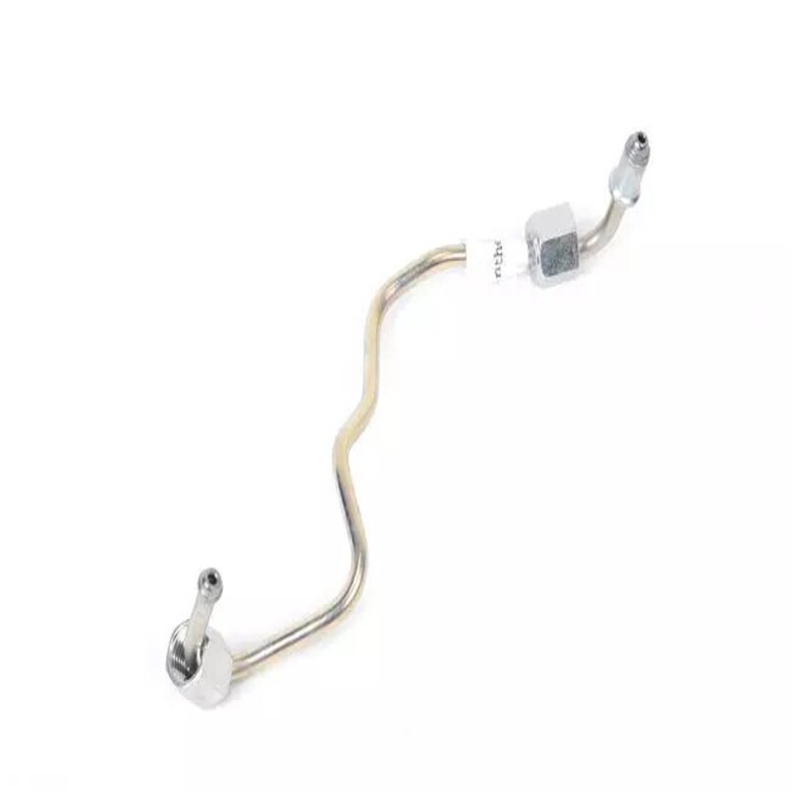 Maintain Peak Engine Performance with a Precision Fuel Injector Line (OE# 98063063)Direct-fit replacement for OE# 98063063. This high-pressure fuel injector line ensures precise diesel delivery, prevents leaks, and restores engine performance. OEM sp...View Product →
Sourcing Replacement Fuel Lines and Fittings Without a Comeback
For repair shops and distributors, a fuel line is a high-risk part: cheap to buy, expensive to warranty if it weeps six months later. A short checklist filters out most problems before an order is placed.
- OE or interchange number first. Fitment by year, make and model is not enough on platforms that changed fuel systems mid-cycle.
- Printed material grade. Nylon tube should show its grade; rubber hose should carry an SAE J30 class marking. No marking means an unverified rating.
- Pressure class above the circuit maximum. Ask for working and burst pressure, not a "high pressure" description.
- Pre-assembled fittings. Lines supplied with the correct quick-connect, flare nut or banjo already fitted remove the most common installation error.
- Corrosion protection. Coated or plated steel and stainless tube matter in salt-belt markets; bare steel can look fine at delivery and be rusted at 30,000 miles.
- Sample and validate. Leak-down, burst, salt spray and thermal cycling before releasing a full order.
Ningbo Jiatian Automobile Pipe Co., Ltd has manufactured automotive pipe since its predecessor plant opened in 1995, operating from a 32,000 m² site with a 26,000 m² workshop. The floor runs 10 CNC automatic benders, 10 hydraulic internal forming machines handling Φ10 to Φ80 and lengths up to 1.5 m, an 800T hydroforming press, two large brazing furnace assembly lines, four automatic laser welders and four welding robots, supported by an in-house development and machining centre and a comprehensive laboratory. For buyers comparing suppliers, that equipment list answers the practical question of whether a factory can hold tolerances on formed tube as well as it can braze and weld a joint. More background is available on our company profile.
Fuel Lines and Fittings: Common Questions
Our Main Products

 Contact Us
+86-138 0586 3066
+86-574 8840 6311
 Products
 Send An E-mail
 Mobile
Copyright ©NINGBO JIATIAN AUTOMOBILE PIPE CO.,LTD. All Rights Reserved.
 China's Premium Automotive Tube Factory
Custom Automotive Pipe Fittings Supply
privacy
China's Premium Automotive Tube Factory
Custom Automotive Pipe Fittings Supply
privacy