

 English
 Español
PTFE Fuel Line: Temperature Limits, Fittings, and Where It Beats Rubber Hose
Content
Pull a ten-year-old rubber fuel hose off a warm engine bay and you will often find the liner hardened, swollen where it soaked in ethanol-blended fuel, or sweating a film of hydrocarbons you can smell long before you can see it. That failure mode — heat plus fuel plus time — is exactly what a PTFE fuel line was engineered to end.
The short version up front: braided PTFE is the most durable fuel line you can run when the route passes near exhaust heat, when the fuel is E85 or methanol, or when the system must hold roughly 60 psi for years without seeping vapor. For a short, cool, low-budget run on pump gas, conventional rubber EFI hose remains a sensible choice. Everything else about a PTFE install — crimped fittings, bend radius, chafe protection — follows from that decision, and it is also where most installations go wrong.
 Stainless Braided PTFE Fuel LineWith a PTFE liner and stainless steel braid, this fuel line resists heat, abrasion, and corrosive fuels like E85 while holding high pressure for years. It suits the demanding exhaust-adjacent routing discussed here, making it worth a look at this point.View Product →
What a PTFE Fuel Line Actually Is
A PTFE fuel line is a composite hose: an extruded polytetrafluoroethylene liner that carries the fuel, wrapped in a woven stainless steel braid that gives the assembly its burst strength and abrasion resistance. PTFE belongs to the same fluoropolymer family as non-stick coatings, and two of its properties decide everything:
- Chemical inertness. Gasoline, diesel, ethanol, methanol — the liner does not react, swell, or harden in any of them, which is why it is the default answer for alcohol-fueled builds.
- A wide temperature window. Commonly published ratings for braided PTFE run from about -70°F up to 450°F; always confirm the exact datasheet for the hose you buy, since ratings vary by wall thickness and braid construction.
The braid turns that liner into a pressure vessel. Published burst figures for braided PTFE sit far above the 55–65 psi a port-injection rail actually sees, so in practice the limit is defined by the end fittings and the quality of the crimp, not the hose wall. On direct-injection engines, the pump-to-rail segment stays steel regardless of hose technology; PTFE serves the low-pressure feed and return side.
Where PTFE Beats Rubber Hose
Temperature headroom
Rubber fuel-injection hose built to SAE 30R7 is typically rated around 250°F continuous. That sounds generous until you measure the space above an exhaust manifold in summer traffic, where radiant heat can push past the rating for hours at a time. Braided covers change the math. According to manufacturers' published datasheets, a CPE-lined braided hose is commonly rated near 300°F, fluoroelastomer-lined versions around 350°F, and braided PTFE near 450°F.
| Hose type | Liner | Typical max temp | Fuel compatibility | Fitting method |
|---|---|---|---|---|
| Rubber EFI hose (SAE 30R7) | NBR/CR rubber | ~250°F | Gasoline, limited E10 | Clamp or crimp |
| CPE braided hose | CPE | ~300°F | Gasoline, E10 | Push-on barbs or crimp |
| FKM-lined braided hose | Fluoroelastomer | ~350°F | Gasoline, E85-rated variants | Crimp |
| PTFE braided hose | PTFE + stainless braid | ~450°F | Gasoline, diesel, E85, methanol | Crimped PTFE fittings only |
Typical continuous ratings compiled from manufacturers' datasheets.
Permeation and evaporative emissions
Rubber is a sponge at the molecular level: hydrocarbon molecules migrate straight through the wall, which is why a garage with rubber fuel lines smells of fuel and why evaporative-emission programs such as California's CARB rules keep pushing low-permeation materials into fuel systems. Permeation is measured under procedures like SAE J1737, and the published trend is consistent: rubber loses measurable vapor over time, while fluoropolymer barriers stay close to zero.
Illustrative trend indexed to rubber = 100, following SAE J1737 permeation-test behavior; absolute values vary by compound.
The Trade-Offs Nobody Mentions Until Install Day
PTFE rewards precision and punishes shortcuts. Two areas cause almost every problem report you will read.
Fittings: crimp, never clamp
The most common mistake is treating PTFE like rubber. PTFE does not stretch over a barbed nipple, so a screw clamp will weep no matter how tight you crank it. Braided PTFE hose needs dedicated crimp or swage fittings, assembled with the correct jaws and dies: a clean square cut, lubricant on the liner, and fresh hardware every time — crimped joints are not reusable. Done right, the joint is torqued to spec and pressure-tested before the first start. For joint integrity in general, our guide on how to prevent leaks in automotive pipe fittings walks through the details.
Routing, chafe protection, and grounding
Stainless braid is an excellent saw blade against plastic tanks, wiring looms, and painted frames. Sleeve every bulkhead pass, support long runs, and respect the minimum bend radius — most -4 PTFE assemblies list roughly 2.5 to 3 inches, and tighter bends risk kinking the liner and choking flow. Finally, ground the braid through its metal fittings so static charge cannot accumulate along the line.
Sizing and Application: Which Line for Which Job
Line size follows flow, not fashion:
- -3 AN — low-flow carbureted and return lines.
- -4 AN — the default for street EFI supply runs.
- -6 AN — high-output or forced-induction builds; return lines typically run one size down.
Match the choice to your fuel pump's flow curve rather than to a horsepower rule of thumb. Diesel owners face a different split: the pump-to-injector lines stay steel because of extreme pressure, while PTFE excels on the lift-pump, feed, and return circuits. If hard starting or power loss has you chasing the fuel side, our overview of fuel delivery issues in diesel engines explains how each segment behaves.
Automotive Fuel Supply Line from a 30-Year ManufacturerProduced by a maker of automotive pipe fittings since 1995, this supply line moves fuel from tank to injector with corrosion-resistant materials and leak-proof connections. CNC bending and swaging ensure the stable geometry and repeatable crimps highlighted above.View Product →How OE-Quality Replacement Fuel Lines Are Made
Specifying braided PTFE is only half the job; the other half is who bends the tubes, forms the ends, and crimps the joints. The manufacturer behind this catalog, Ningbo Jiatian Automobile Pipe, has built automotive pipe fittings since its predecessor factory opened in 1995 — more than 30 years on the same product family, according to the company's engineering overview. The production floor pairs CNC bending machines and large brazing-furnace assembly lines with hydraulic and water-swage forming equipment, automated laser welding, welding robots, and machining centers for end fittings, all backed by an in-house laboratory for material and quality checks. The same logic that makes braided PTFE attractive — stable geometry, repeatable crimps, clean internals — is applied to the OE-replacement fuel lines, injector feed pipes, and supply lines below.
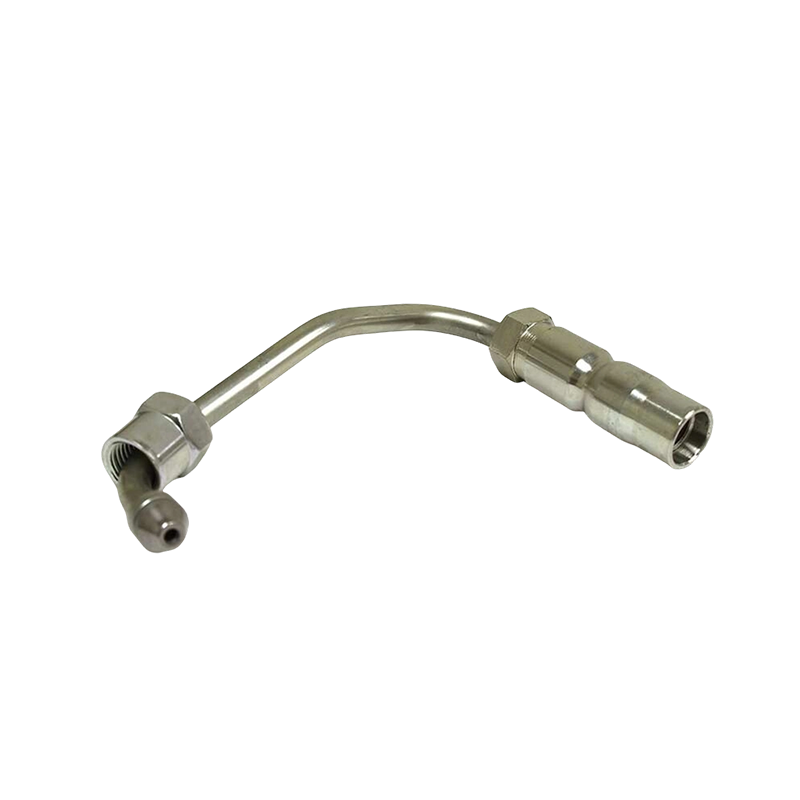 High-Pressure Fuel Injector Feed PipeThis alloy steel feed pipe carries ultra-high-pressure fuel from the common rail to each injector, with cold drawing, heat treatment, and prestressing for fatigue life. Strict cleanliness testing aligns with the repeatable, clean internals emphasized above.View Product →
PTFE Fuel Line: Frequently Asked Questions
Only versions whose hose and crimp ends are certified by the manufacturer carry that status; many motorsport lines are off-road only. Check the datasheet before a street install.
No. PTFE does not stretch over a barb like rubber, so clamped joints leak. Use crimped fittings made specifically for PTFE hose.
Yes. The liner is chemically inert to alcohol blends, which is one of the main reasons builders choose it over rubber.
As a rule of thumb, -4 AN covers most street EFI supply runs and -6 AN suits high-output or forced-induction builds; match the size to your pump's flow.
Respect the catalog figure: a typical -4 hose lists a minimum bend radius around 2.5–3 inches. Tighter bends can kink the liner and restrict flow.
Usually assembly error: a wrong fitting, worn crimp jaws, or a rough liner cut. Rebuild the joint with fresh hardware instead of adding clamp pressure.
Yes, and it works well on vapor and return runs thanks to its low permeation; just keep the system's pressure rating in mind.
In typical service, decades — the liner does not oxidize, swell, or harden. Inspect the braid at chafe points once a year.
Our Main Products


 Contact Us
+86-138 0586 3066
+86-574 8840 6311
 Products
 Send An E-mail
 Mobile
Copyright ©NINGBO JIATIAN AUTOMOBILE PIPE CO.,LTD. All Rights Reserved.
 China's Premium Automotive Tube Factory
Custom Automotive Pipe Fittings Supply
privacy
China's Premium Automotive Tube Factory
Custom Automotive Pipe Fittings Supply
privacy